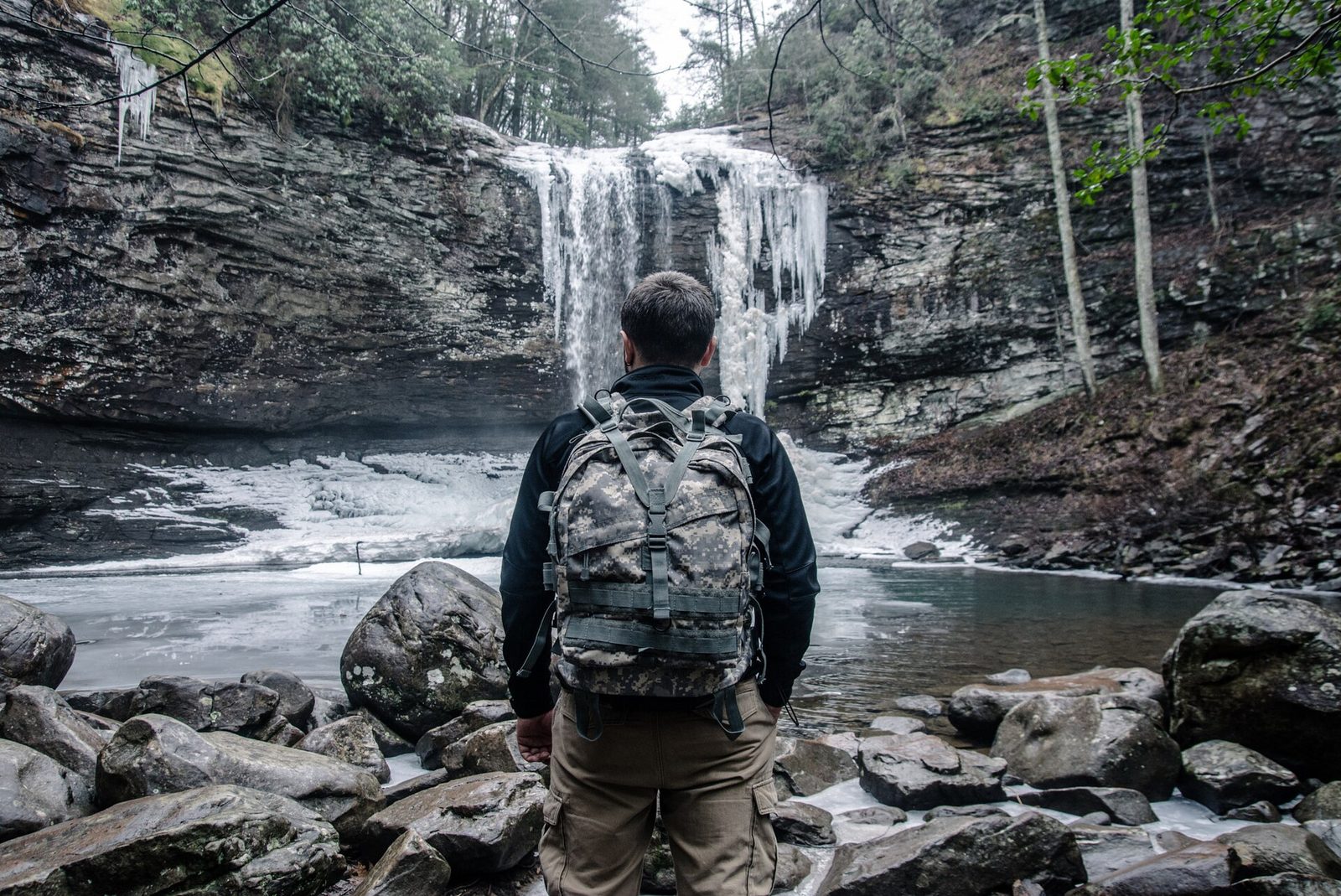
On 1 January 2026 the price of parking at a Georgia state park doubled, from $5 a day to $10, and a lot of people have not done the arithmetic on what that changed. If you hike three weekends a month you are now paying $70 a year more than you were, which happens to be exactly what the annual pass costs. That single fact reorganizes how you should approach Georgia state parks, and it is where this guide starts.
Georgia’s Department of Natural Resources runs 49 state parks and more than 60 historic sites across upwards of 84,000 acres — a system that stretches from a canyon on Lookout Mountain in the northwest corner to a dark-sky park deep in the Okefenokee Swamp, with everything from granite monadnocks to salt marsh in between. The problem is not that there is nothing to do. It is that the official site is organized as a database and every third-party list ranks the same eight parks without telling you how far away they are, what the fees actually cover, or which ones will turn you away at the gate.
This page fixes that. It compares the parks by drive time from Atlanta, signature feature and what you can realistically do in a day; explains the pass, the historic-site trap and the reservation window; and says plainly which parks are worth a long drive and which are campgrounds with a lake attached. Prices were checked in September 2026 and are date-stamped. This is Georgia the US state, incidentally — the search results mix it with the country of the same name, and the parks below are all within a day’s drive of Atlanta.
Georgia State Parks at a Glance
| Question | Short answer |
|---|---|
| What does it cost to park? | $10 per vehicle per day (ParkPass), up from $5 on 1 January 2026. Annual pass $70. |
| When does the annual pass pay? | At seven visits a year. Below that, pay daily. |
| Does the pass cover historic sites? | No. Historic sites charge per-person admission instead. This is the most expensive surprise in the system. |
| Camping and cabins | Campsites roughly $23–$50; cottages $75–$250; yurts $75–$100. |
| How far ahead can I book? | 13 months for anyone, 14 months for Georgia residents. |
| Dogs? | Yes, leashed to six feet, in over 40 campgrounds with no pet fee. Most cabins are not dog-friendly. |
| Best single park | Cloudland Canyon, if you will do the stairs. Tallulah Gorge if you want drama with less commitment. |
| Biggest rookie error | Driving to Tallulah Gorge expecting to walk the gorge floor. It needs a free permit, 100 a day, usually gone by 09:00 in summer. |
The Pass, the Fees, and What They Cover
ParkPass
Parking at a Georgia state park requires a ParkPass: $10 per vehicle per day, or $70 for the year (checked September 2026). The annual pass is discounted 50% for visitors aged 62 and over and 25% for military and veterans, but those discounts are in person only — you cannot get them online, which catches people out. Larger vehicles pay more: 13 to 30 seats is $50 a day or $90 a year, and over 30 seats is $100 a day or $275 a year.
The maths is simple. At $10 a visit, the $70 annual pass pays for itself on the seventh day. If you live in Georgia and hike at all regularly, buy it in January. If you are visiting the state for a week and will see three parks, pay by the day and do not let anyone upsell you.
The historic sites trap
Here is the thing that costs people money at the gate. Georgia’s system contains state parks and state historic sites, and they are funded differently. Historic sites — Wormsloe outside Savannah, Etowah Indian Mounds, the Dahlonega Gold Museum, Fort King George and the rest — charge per-person admission instead of per-vehicle parking, and your ParkPass does not cover them.
A family of four arriving at Wormsloe with an annual pass in the windshield will still pay admission for four people. Check which category a site falls into before you plan around your pass, because the difference for a family is substantial and the signage does not make it obvious until you are at the window.
Booking Cabins, Campsites and Yurts
Overnight rates sit in fairly consistent bands: campsites $23 to $50, cottages and cabins $75 to $250 depending on park, season and size, and yurts $75 to $100 (September 2026). Individual park rates live behind the booking system, so treat those as planning figures.
The booking window is the part worth knowing. Reservations open 13 months ahead for everyone and 14 months ahead for Georgia residents, who get the extra month as a deliberate benefit. In practice that means the good cabins at Vogel, Cloudland Canyon and Amicalola Falls for an October weekend are claimed roughly a year out, by residents, before out-of-state visitors can even see the calendar. If you want fall color from a cabin porch, you are planning it the previous autumn.
A 50% deposit confirms a booking made 15 or more days ahead, with the balance due at check-in; book inside 14 days and you pay in full. Reservations go through gastateparks.org or 1-800-864-7275.
One honest note on value: a state park cottage at the top of that range, around $200 to $250 a night, is competing with a decent hotel and often a nicer private rental. What you are buying is the location — waking up inside the park, before the day-use crowd arrives — and on a busy weekend that is worth a great deal. On a quiet Tuesday in February it may not be.
The Parks, Region by Region
Northwest Georgia
Cloudland Canyon (Rising Fawn, about 2 hours from Atlanta) is the best state park in Georgia and it is not especially close. Two waterfalls, a thousand-foot canyon cut into Lookout Mountain, a rim trail with genuine long views, and yurts and cottages on the edge. Fort Mountain (Chatsworth, about 1 hour 45) has an 855-foot prehistoric rock wall along its summit whose builders and purpose remain genuinely unknown, plus a CCC stone tower and a good lake.
Northeast Georgia and the mountains
This is where the system is densest. Tallulah Gorge (about 1 hour 45) is the spectacle. Amicalola Falls (about 1 hour 15) has the state’s headline waterfall and the approach trail to the Appalachian Trail. Vogel (about 1 hour 45), one of Georgia’s two original parks from 1931 and built out by the Civilian Conservation Corps, sits under Blood Mountain with a small lake and some of the most-booked cabins in the system. Black Rock Mountain (about 2 hours) is the highest state park in Georgia at 3,640 feet, straddling the Eastern Continental Divide. Unicoi sits beside Helen; Smithgall Woods and Moccasin Creek are the quiet ones.
Within an hour of Atlanta
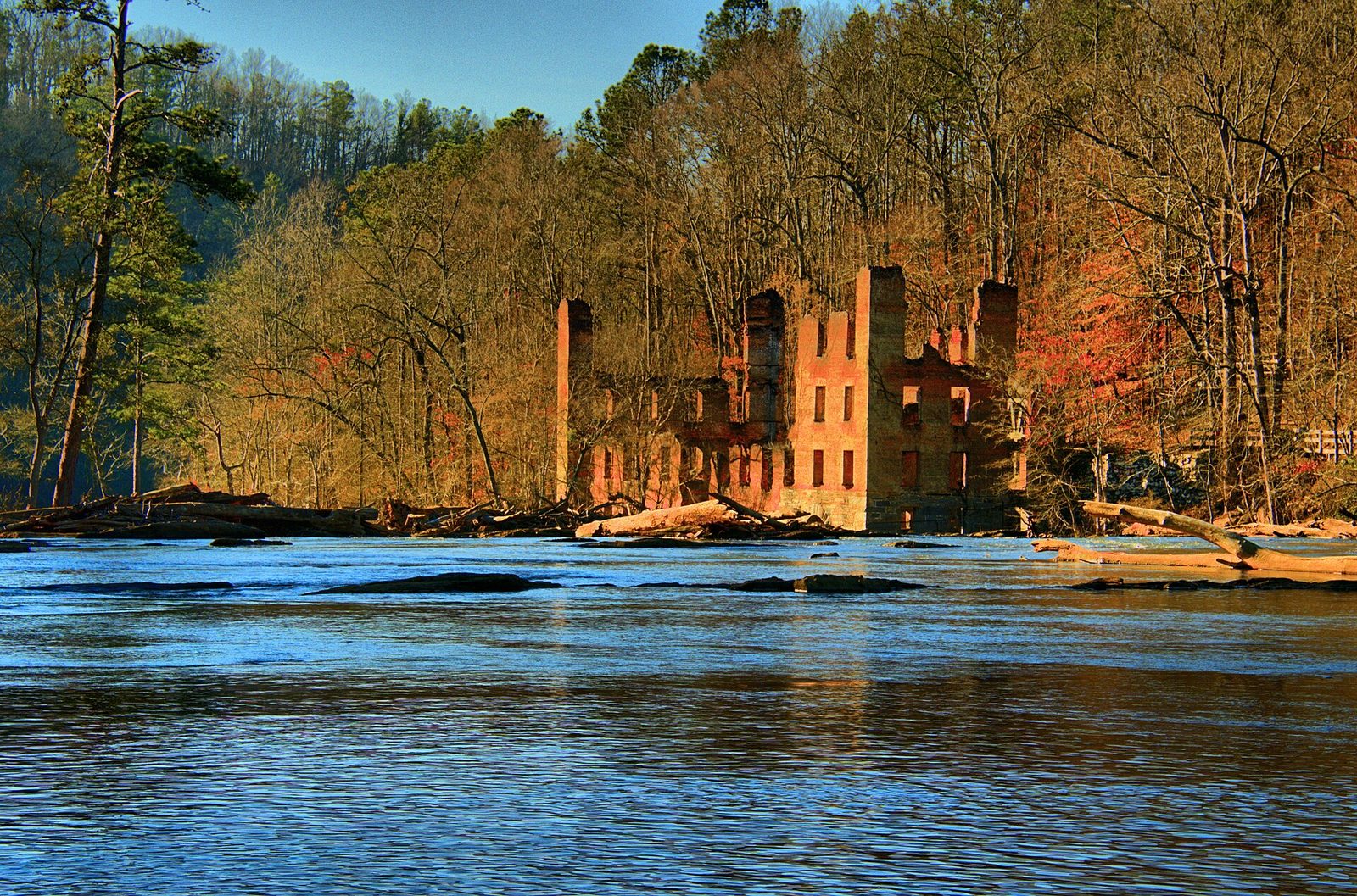
Sweetwater Creek (Lithia Springs, 30 minutes from downtown) is the best short-notice park in the state: a rocky creek, a steep red trail, and the burned-out brick shell of the New Manchester mill, torched by Union troops in 1864 along with the town around it. Red Top Mountain on Lake Allatoona and Fort Yargo near Winder are the reliable lake-and-trail options; Panola Mountain protects a granite monadnock where the summit is accessible only on guided hikes, which is why it still has lichen on it; Don Carter on Lake Lanier is the newest park in the system.
Middle and west Georgia
F.D. Roosevelt State Park (Pine Mountain, about 1 hour 20) is the largest in the system, with the 23-mile Pine Mountain Trail and Dowdell’s Knob, where Roosevelt used to drive out to picnic and look south. Indian Springs claims to be among the oldest state parks in the country. Providence Canyon (about 2 hours 30) is the famous one — see the honest verdict below. Watson Mill Bridge has the longest covered bridge in Georgia.
South Georgia and the coast
Stephen C. Foster (Fargo, about 4 hours 30) is the western gateway to the Okefenokee and Georgia’s first International Dark Sky Park — the darkest accessible night sky east of the Mississippi and the single most underrated thing in the system. Skidaway Island gives you salt marsh boardwalks twenty minutes from Savannah. Crooked River is the practical base for the Cumberland Island ferry. George L. Smith is a cypress mill pond you paddle through. Laura S. Walker, Reed Bingham, General Coffee and Seminole round out the south.
| Park | Region | From Atlanta | Signature feature | Effort |
|---|---|---|---|---|
| Sweetwater Creek | Metro Atlanta | ~30 min | Mill ruins, rocky creek | Easy–moderate |
| Panola Mountain | Metro Atlanta | ~30 min | Guided-access granite summit | Easy |
| Red Top Mountain | Metro Atlanta | ~40 min | Lake Allatoona, easy trails | Easy |
| Fort Yargo | Northeast | ~50 min | Lake loop, mountain biking | Easy |
| Amicalola Falls | North | ~1 hr 15 | 729 ft falls, 604 stairs | Strenuous stairs |
| F.D. Roosevelt | West | ~1 hr 20 | Pine Mountain Trail, Dowdell’s Knob | Easy–strenuous |
| Tallulah Gorge | Northeast | ~1 hr 45 | 1,000 ft gorge, suspension bridge | Moderate–strenuous |
| Vogel | North | ~1 hr 45 | CCC park under Blood Mountain | Easy–moderate |
| Fort Mountain | Northwest | ~1 hr 45 | Prehistoric stone wall | Moderate |
| Black Rock Mountain | Northeast | ~2 hr | Highest park, 3,640 ft | Moderate |
| Cloudland Canyon | Northwest | ~2 hr | Two waterfalls, canyon rim | Strenuous stairs |
| Providence Canyon | Southwest | ~2 hr 30 | Eroded clay gullies | Easy–moderate |
| George L. Smith | Southeast | ~3 hr | Cypress mill pond paddling | Easy |
| Skidaway Island | Coast | ~4 hr 15 | Salt marsh boardwalks | Easy |
| Stephen C. Foster | South | ~4 hr 30 | Okefenokee, Dark Sky Park | Easy |
Drive times are from central Atlanta in normal traffic and should be treated as optimistic on a Friday afternoon.
The Five Worth Planning a Trip Around
Cloudland Canyon
Two hours northwest, on the western edge of Lookout Mountain and close enough to Chattanooga that a lot of its visitors come from Tennessee. The main event is the Waterfalls Trail, a set of metal staircases — more than 600 steps — dropping to Cherokee Falls and then further to Hemlock Falls. Going down is easy and going back up is a genuine workout in July; people underestimate this constantly.
The West Rim Loop, about 4.5 miles, is the better trail if you want views rather than waterfalls, and it is where the canyon reads at full scale. The park has cottages, yurts, walk-in campsites on the rim and a separate entrance at Sitton’s Gulch at the bottom. Go on a weekday if you possibly can; the parking lots fill by mid-morning on summer and autumn weekends.
Tallulah Gorge
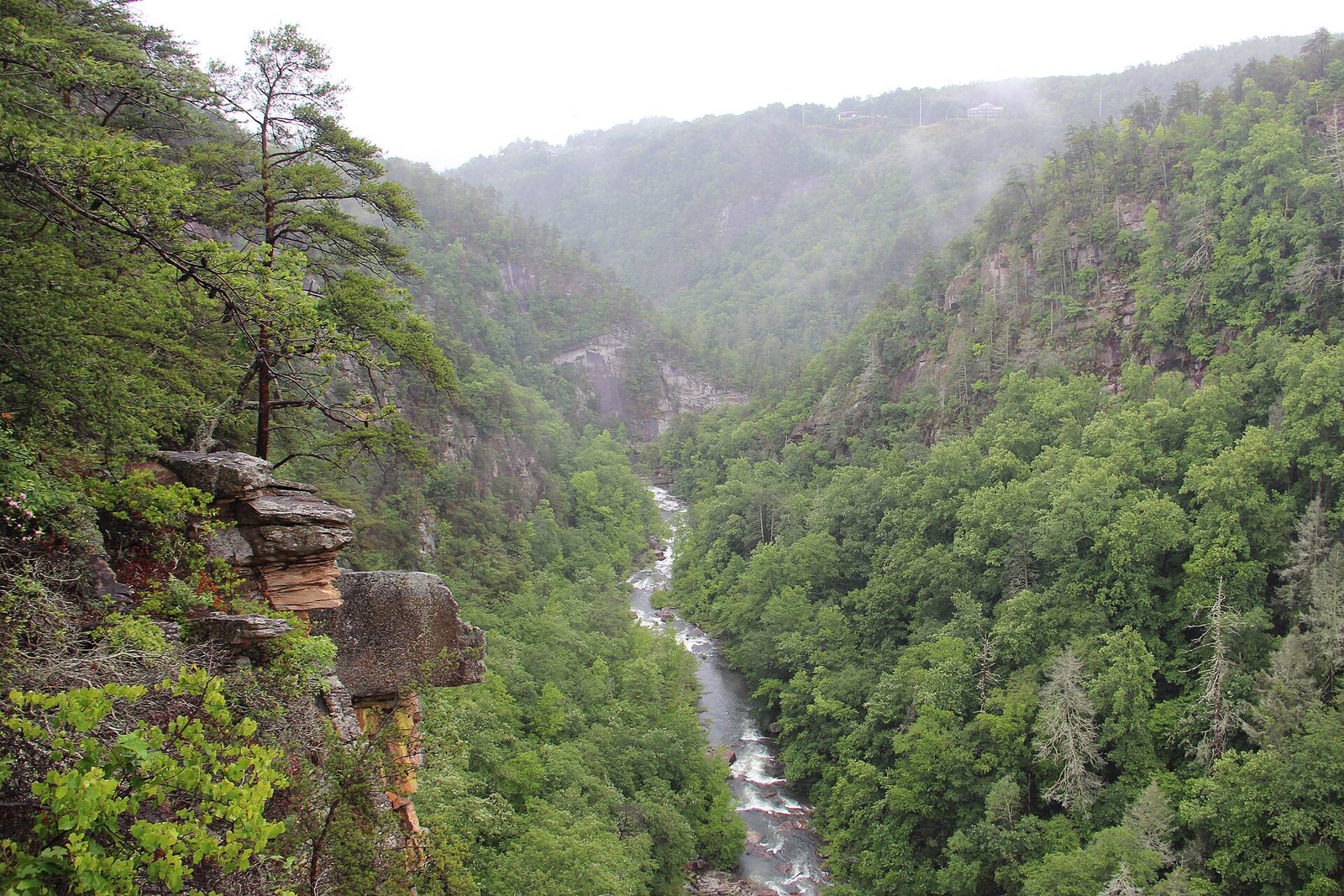
Two miles long and roughly 1,000 feet deep, with a suspension bridge hanging about 80 feet above the riverbed and rim trails on both sides. It is the most dramatic thing in north Georgia that you can see from a paved overlook in ten minutes.
The catch, and it is a big one: walking the gorge floor requires a free permit, and only 100 are issued per day. They are handed out from 08:00 at the Jane Hurt Yarn Interpretive Center, and on a summer weekend they are gone by about 09:00. Last permits go out at 16:00 from April to October and 15:00 from November to March. Closed-toe shoes are required — no flip-flops, no Crocs, and rangers do check. And there are no permits at all during scheduled water releases, when the dam upstream sends the river down at whitewater volume.
People drive two hours from Atlanta, arrive at eleven, and discover all of this at the desk. The rim trails and the suspension bridge do not need a permit and are worth the trip on their own, but if the gorge floor is the point, leave Atlanta at six.
Amicalola Falls
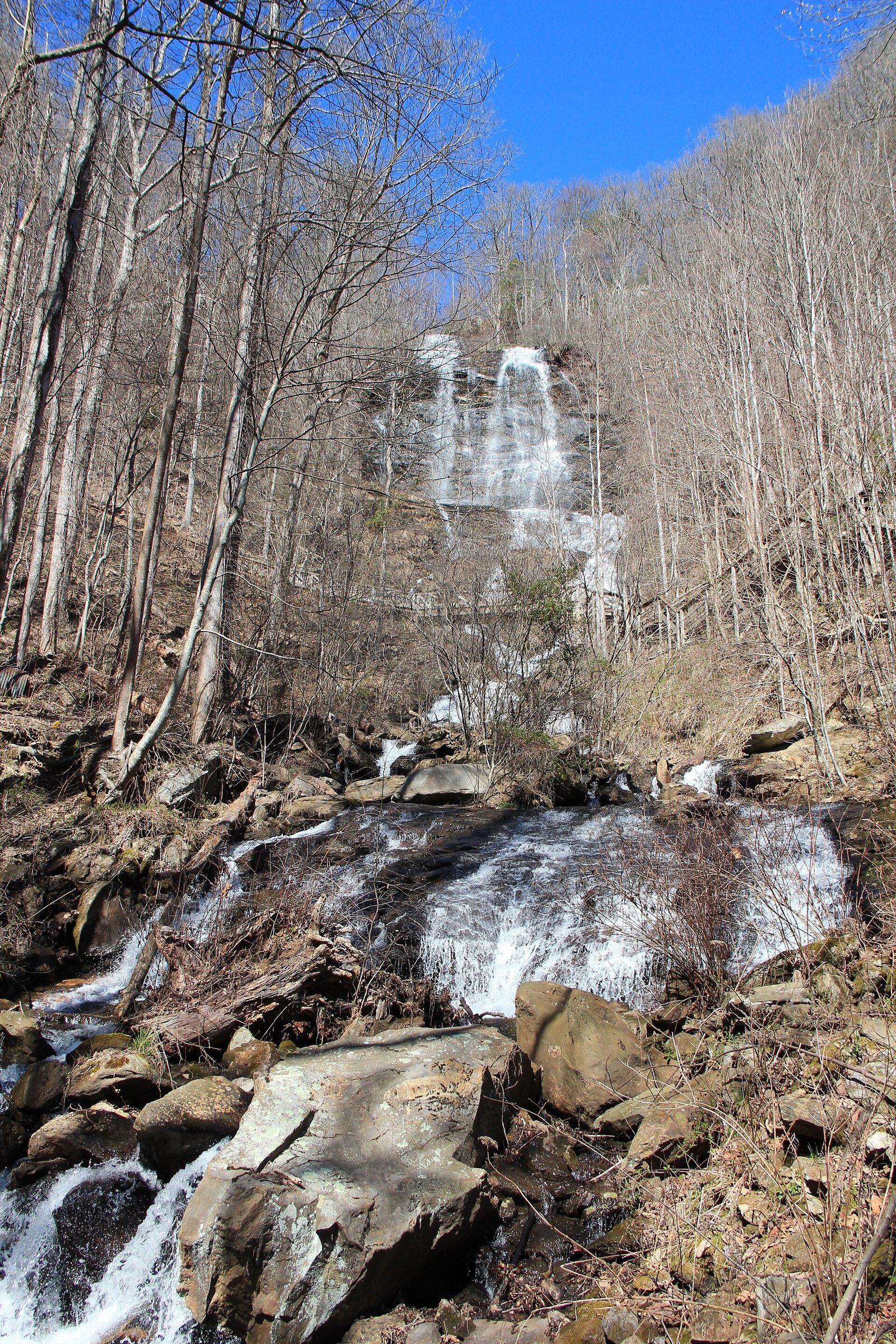
A 729-foot cascade, described as the tallest cascading waterfall east of the Mississippi — a carefully qualified claim, since “cascading” excludes taller single drops elsewhere, but the thing itself is genuinely impressive. There are 604 stairs from bottom to top, and you can cheat by driving to the upper lot and walking down to the viewing platform instead.
The park is also the practical start of the Appalachian Trail for a lot of thru-hikers: the 8.5-mile approach trail runs from the arch here to Springer Mountain. Five miles in, reachable only on foot, the Len Foote Hike Inn offers beds and meals to people who walk to it — one of the most distinctive overnight stays in the Southeast, and it books well ahead.
Providence Canyon
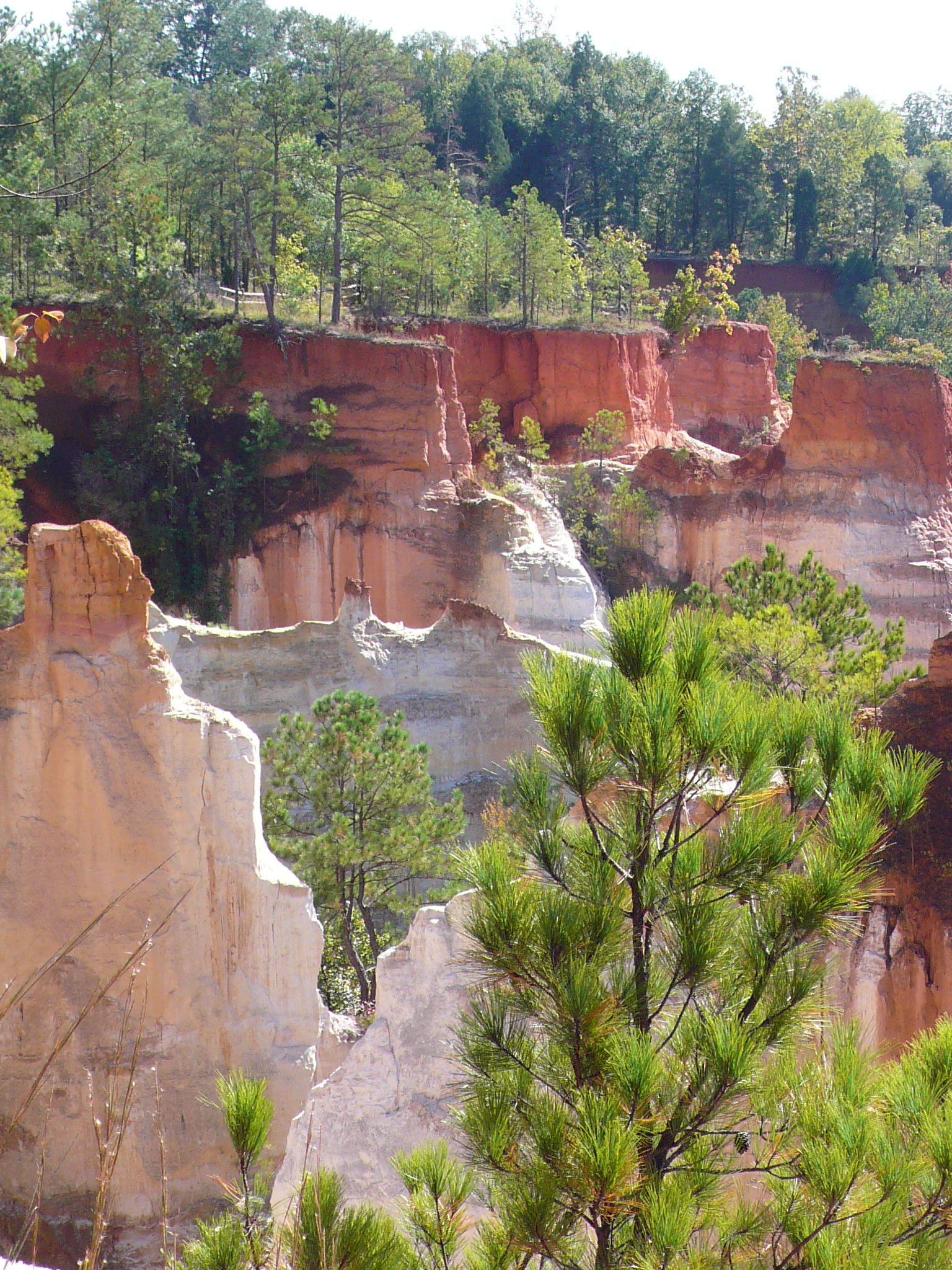
Georgia markets this as the “Little Grand Canyon”, and the gullies — pink, orange, white and gray-banded clay, up to 150 feet deep, with pines growing improbably from the floor — really are extraordinary to look at. The White Loop is about three miles and takes you along the canyon floor between the walls.
Now the honest part, because it is more interesting than the marketing. Providence Canyon is not a natural landform. It is an erosion scar, gouged out over the past two centuries by poor farming practice on soft coastal-plain soil — ditches that started as drainage furrows in the 1800s and ran away with themselves. You are looking at a very beautiful environmental accident, and it is still growing. That does not make it less worth seeing; it makes it a better story than the one on the sign.
The practical caveat: it is two and a half hours from Atlanta in the far southwest of the state, and the walking is about three hours. Do not drive down for the afternoon. Pair it with Florence Marina on Lake Walter F. George, or with Kolomoki Mounds, and make a weekend of it.
Stephen C. Foster
Four and a half hours from Atlanta at the end of a long road through Fargo, on the western edge of the Okefenokee. It is Georgia’s first International Dark Sky Park, and the night sky there is the real attraction — on a moonless night you can see the Milky Way cast a shadow, which is not a thing you can do anywhere near a Georgia city.
Entry to the refuge is $5 per vehicle for 7 days (or $15 annual) at the Folkston entrance, valid here too, and America the Beautiful passes waive it. Refuge hours run from half an hour before sunrise to 19:30 March–October and 17:30 November–February. The refuge runs no tours of its own; Stephen C. Foster does (912-637-5274). The swamp was inscribed as a UNESCO World Heritage Site in July 2026, the 27th in the United States, which has not yet fed through into visitor numbers but will.
One current caveat: low water has been limiting boat and trail access in the Okefenokee. Call before you commit to a five-hour drive.
State Parks Versus Everything Else Green in Georgia
A good deal of confusion — and a fair number of wasted ParkPass days — comes from people assuming that anything wooded with a sign at the entrance is a state park. It is not, and the four other categories run on completely different rules.
Chattahoochee-Oconee National Forest covers most of the north Georgia mountains, including Brasstown Bald, Anna Ruby Falls, Raven Cliff Falls, Blood Mountain and the Georgia stretch of the Appalachian Trail. It is federal, it is not covered by your ParkPass, and it charges at a handful of staffed recreation areas while most trailheads are free. This trips people up constantly: Unicoi is a state park, but Anna Ruby Falls, two miles up the road from it, is national forest with its own separate fee.
National Park Service sites in Georgia are their own thing again: Cumberland Island National Seashore, Martin Luther King, Jr. National Historical Park, Kennesaw Mountain National Battlefield Park, Ocmulgee Mounds, Fort Pulaski and the Chattahoochee River National Recreation Area. Some are free, some charge per person, and the America the Beautiful annual pass covers them — which the ParkPass does not.
National wildlife refuges, including the Okefenokee, are run by the US Fish and Wildlife Service, charge their own small vehicle fee, and are managed for wildlife rather than recreation, which is why facilities are thinner and hours are tied to sunrise and sunset.
And Army Corps of Engineers land surrounds the big reservoirs — Lanier, Allatoona, Hartwell, Clarks Hill — with its own campgrounds and day-use areas that are neither state nor park service.
The practical upshot: if you are spending a week outdoors in north Georgia, you may want a ParkPass and an America the Beautiful pass, and neither one gets you everything. Work out which category each place on your list falls into before you buy either.
Swimming, Lakes and Water
Georgia summers make this more important than it sounds. Several parks run seasonal beaches and swimming areas on their lakes — Vogel, Red Top Mountain, Fort Yargo, Unicoi and High Falls among them — typically open from late May through Labor Day and included with your parking fee. Amicalola Falls and Tallulah Gorge do not have swimming, which surprises people who have driven up with towels.
For paddling, the standouts are George L. Smith, where you take a kayak through a flooded cypress mill pond, and Stephen C. Foster, where you paddle into the Okefenokee proper. Both rent boats on site. Most lake parks rent kayaks, canoes and pedal boats by the hour in season, which is usually cheaper than hauling your own.
Camping, Cabins and Yurts: What You Actually Get
Campsites at $23 to $50 are the best value in the system. Most sites have water and electric hookups, a pad, a fire ring and a picnic table, with a bathhouse in the loop. Walk-in and backcountry sites cost less and exist at a good number of parks, including Cloudland Canyon’s rim sites, which are the best tent pitches in Georgia.
Cottages, at $75 to $250, are full cabins with kitchens, bathrooms, heat and air conditioning, and usually a screened porch. They range from 1930s CCC stone cabins — Vogel and F.D. Roosevelt have the best of these — to 1990s builds with much less character. The CCC ones are worth going out of your way for and are also the hardest to book.
Yurts, $75 to $100, are the underrated middle option: a raised platform, a canvas dome, real beds, a deck, no plumbing. They sleep six, they are warm enough for spring and autumn, and they let you take a group to Cloudland Canyon or Fort Yargo without anyone owning a tent.
Dogs
Georgia’s parks are unusually good for dogs. Leashed pets are welcome throughout the parks, including on almost all hiking trails, with the leash limited to six feet and the owner present at all times. More than 40 parks have campgrounds that accept dogs of any breed or size with no extra pet fee, which is better than most state systems and considerably better than most private campgrounds.
Cabins are the exception. Some parks have designated dog-friendly cottages; most do not, and turning up with a dog and a non-pet cabin booking will not end well. Filter for it when you book. A few specific areas — swimming beaches, some interpretive zones — exclude pets, so check the individual park page rather than assuming.
Accessibility
The picture is mixed, and worth researching per park rather than in general. The strongest options are the boardwalk parks: Skidaway Island‘s salt marsh boardwalks, the observation decks at Stephen C. Foster, and the paved overlooks at Tallulah Gorge, which give you the full gorge view without the rim trail. Amicalola Falls has a reflection pool and lower viewing area reachable by car and a short paved path, meaning you can see the falls without the 604 steps. Many parks have accessible cottages and accessible campsites, bookable as such.
The weakest are the canyon parks’ main attractions: Cloudland Canyon’s Waterfalls Trail is stairs from beginning to end, and Providence Canyon’s floor is loose sand and standing water in places. Visitor centers, picnic areas and fishing piers are generally accessible system-wide. Contact the individual park — most have a specific answer rather than a generic policy.
Crowds, Seasons and Timing
October is peak everything. North Georgia fall color runs late October, about a fortnight after the Smokies, and Cloudland Canyon, Vogel, Black Rock Mountain, Tallulah and Amicalola all fill their parking lots by mid-morning on those weekends. Cabins for those dates go a year ahead. If you want the mountains in autumn, go midweek or go the first week of November when the color has slid downhill.
Spring is the underrated season: wildflowers in April, waterfalls running full from winter rain, and none of the heat. Summer means the water parks — lake swimming at Red Top Mountain, Fort Yargo and Vogel — and an early start anywhere with stairs. Winter is genuinely the best time for the canyon parks, because the leaves are off and you can actually see the landform. Cloudland Canyon and Amicalola in January are transformed, and empty.
The general rule across the system: arrive before 10:00 on any weekend at a headline park, or arrive after 15:00 and accept a short visit. The middle of a Saturday is the worst of it.
Check the Alerts Before You Drive
This is the habit that separates a good trip from a wasted drive. Georgia’s parks post current alerts — trail closures, water releases, low water, bridge work, prescribed burns, flooding — on the individual park page, and they change weekly. The specific things that have turned people away recently: Tallulah’s gorge-floor permits suspended during scheduled water releases, Okefenokee boat access limited by low water, and storm damage closing trail sections in the north Georgia parks after heavy rain.
Check the park’s own page the morning you leave, and call if the drive is over two hours. Rangers answer the phone, and they will tell you the truth about conditions.
Where the System Falls Short
Three honest observations.
First, a lot of the parks are campgrounds with a lake. That is not an insult — a clean, cheap, well-run campground beside water is exactly what most people want on a Friday night, and Georgia has plenty of them. But if you are driving three hours expecting a Cloudland Canyon and you arrive at a pleasant lakeside loop with a boat ramp and a two-mile nature trail, you will be disappointed. Match the park to the trip.
Second, the fee increase has not visibly bought much yet. Doubling day-use parking in one step is a large increase, and while the maintenance backlog across the system is real and the money is needed, a visitor in 2026 will not notice a difference against 2025. That may change.
Third, the website is organized for the department, not for you. Finding out whether a specific cabin takes dogs, whether a trail is open, and what the site actually charges takes three clicks too many at every step, and the historic-site distinction that costs families money is never stated where it would help. Phone the park.
Three Weekends That Work
The northwest canyon weekend
Friday night at Cloudland Canyon in a yurt or rim campsite. Saturday: the Waterfalls Trail early, the West Rim Loop after lunch. Sunday: Fort Mountain on the way home for the stone wall and the tower. Two parks, one ParkPass day each, about five hours of driving all told.
The mountains in fall
Book a CCC cabin at Vogel a year ahead. Saturday: Tallulah Gorge with an 08:00 permit run, rim trails afterwards. Sunday: Amicalola Falls and the approach-trail arch, then home. Add Brasstown Bald — federal land, not a state park, and the highest point in Georgia — if the weather is clear.
The southwest, properly
Providence Canyon on Saturday morning while the light is still low in the gullies, Florence Marina or Kolomoki Mounds in the afternoon, a night nearby, and F.D. Roosevelt and Dowdell’s Knob on the way back north. This is the trip that makes the two-and-a-half-hour drive to Providence make sense.
Frequently Asked Questions
How much does it cost to visit a Georgia state park?
Parking is $10 per vehicle per day through the ParkPass system, or $70 for an annual pass, as of 2026. There is no separate per-person entry fee at state parks. Historic sites are different and charge per-person admission, which the ParkPass does not cover.
Is the annual Georgia ParkPass worth it?
It pays for itself on the seventh visit. If you live in or near Georgia and get out most months, buy it. If you are visiting for a week, pay the daily rate. Note that the 50% senior and 25% military discounts on the annual pass are only available in person, not online.
Which is the best Georgia state park?
Cloudland Canyon, on balance — two waterfalls, a serious canyon, good trails at several difficulty levels and the best campsites in the system. Tallulah Gorge gives you more drama for less walking. Stephen C. Foster is the most distinctive, if you will drive four and a half hours for a dark sky.
Do I need a permit to hike Tallulah Gorge?
Only for the gorge floor. Rim trails, the overlooks and the suspension bridge are open to anyone with a ParkPass. The floor needs a free permit, capped at 100 a day, issued from 08:00 at the interpretive center and typically gone by 09:00 on summer weekends. Closed-toe shoes are required, and no permits are issued during scheduled water releases.
Can I bring my dog to a Georgia state park?
Yes — leashed to six feet, with you at all times, on almost all trails and in over 40 campgrounds with no pet fee. Cabins are the exception: only some are dog-friendly, so filter for it when booking rather than arriving and hoping.
How far in advance should I book a state park cabin?
For an autumn weekend in the north Georgia mountains, about a year. The window opens 13 months ahead, or 14 months for Georgia residents, and residents take the best cabins before anyone else can see them. Midweek and off-season, a few weeks is usually enough.
Is Providence Canyon natural?
No. It is an erosion scar created over roughly two centuries by poor farming practice on soft coastal-plain soil, starting from drainage furrows cut in the 1800s. It is genuinely beautiful and still growing, but it is not a natural canyon, and it is a better story for it.
What is the closest state park to Atlanta?
Sweetwater Creek, about thirty minutes west in Lithia Springs, with the New Manchester mill ruins and a properly rocky creek trail. Panola Mountain is about the same distance southeast and much quieter, with a granite summit you can only reach on a guided hike.
Are Georgia state parks open year round?
Yes, though individual facilities, water parks and some trails close seasonally, and any park can close sections after storms. Winter is the best time for the canyon parks, because the leaves are down and the landforms are visible. Always check the park’s own alerts page the morning you leave.
Six of the parks above — Vogel, Unicoi, Amicalola Falls, Black Rock Mountain, Fort Mountain and Tallulah Gorge — sit inside an hour of each other in the same corner of the state, and most people visiting them are staying in a cabin rather than camping. Our north Georgia mountains guide compares the seven base towns, explains how the cabin rental market actually works, and gives peak fall color by elevation rather than as a vague month.
Three of the parks above sit on the coast — Skidaway Island, Crooked River and Fort McAllister — and they make far more sense as part of a coast trip than on their own. Our guide to Georgia’s beaches and islands covers the whole shoreline: which islands have road access, the Cumberland ferry rules, dog and sea-turtle restrictions, and why a six-to-nine-foot tide changes what you can do and when.
Most people use these parks two nights at a time, and the fixed costs are low enough — $10 a day of parking — that a mountain park weekend is the cheapest break in the state. Our guide to weekend getaways in Georgia puts that in context against fourteen other options, from a $59-a-head day on Cumberland Island to a free afternoon at Ocmulgee Mounds, with honest drive times and booking windows throughout.
The cottages, yurts and campsites above are the cheapest good accommodation in north Georgia, and comparing them fairly against a private rental means accounting for the fees a cabin listing leaves off. Our guide to cabins in Georgia does that arithmetic, explains the booking windows on both sides, and is blunt about mountain roads, cell coverage and the mountain view that disappears in May.
Hiking is what most people come to these parks for, and the parks have one quiet advantage over the national forest next door: hunting is not permitted in them, so you can walk Cloudland Canyon, Vogel, Tallulah or Fort Mountain in late October without blaze orange. Our guide to the best hikes in Georgia covers thirty-eight trails with normalized distances and elevation, the permits and parking that actually apply, and the hunting dates that decide where you walk in autumn.
Four of the parks above are really waterfall destinations — Amicalola, Cloudland Canyon, Tallulah Gorge and High Falls — and the falls in them behave very differently through the year. Our guide to waterfalls in Georgia explains the flow season, why the published heights disagree so wildly, which viewpoints are accessible without the stairs, and what the Tallulah water releases actually change.
Several of these parks are within an hour of Atlanta and work as half-day trips — Sweetwater Creek at thirty minutes, Panola Mountain and Arabia at about the same, High Falls and Indian Springs at an hour south. Our guide to day trips from Atlanta places them against twenty other options with honest drive times, timed plans, and a cost table that makes clear how much of the best day-tripping near the city is free or $10.
Park cottages, cabins and yurts are the best-value lodging in Georgia and they are also the hardest to get, which makes them a planning decision rather than a booking one. Our guide to where to stay in Georgia puts the park rates in context against hotels and private cabins, and explains why the absence of a cleaning fee matters more than the nightly figure suggests.
A good many of these parks exist because there is a lake behind them, and the park is often the only easy public access to it — a beach, a boathouse and a car park for the price of a day’s parking. Our guide to lakes in Georgia explains who manages each body of water and how that decides whether you can swim, launch or fish, along with 2026 license costs and dam-release safety.
Sleeping in one of these parks is a different planning problem from visiting one: the reservation window opens 13 months ahead, 14 for Georgia residents, and the lakeside sites at the popular mountain parks are gone almost immediately. Our guide to camping in Georgia covers the booking mechanics, the RV hookup and rig-length reality, and the free dispersed option in the national forest when the parks are full.
In October the parks along the fall-color routes — Vogel, Unicoi, Black Rock Mountain, Fort Mountain — fill early and stay full, and the ParkPass that gets you into them is not valid at Brasstown Bald or Anna Ruby Falls, which are Forest Service sites with their own per-person fees. Our north Georgia fall foliage scenic drive guide sets out which fee applies where and when to arrive.
Related Georgia Guides
- Best things to do in Georgia — the statewide overview, region by region, with costs and honest verdicts.
- Best places to visit in Georgia — 35 destinations from the mountains to the barrier islands, ranked by whether the drive pays off.
- Atlanta travel guide — the city most of these parks are a day trip from, planned around where to stay and whether to rent a car.
Photo Credits
Cloudland Canyon waterfall in winter (featured image): photo by Nikolay Loubet / Wikimedia Commons (CC BY 3.0)
Tallulah Gorge from an overlook: photo by Thomson200 / Wikimedia Commons (CC0)
New Manchester mill ruins, Sweetwater Creek State Park: photo by Dianne K Frost / Wikimedia Commons (CC BY-SA 4.0)
Amicalola Falls: photo by Thomsonmg2000 / Wikimedia Commons (CC0)
Providence Canyon: photo by Eoghanacht / Wikimedia Commons (Public domain)
Sources and Corrections
ParkPass rates, overnight rate bands, the reservation window and the pet policy were checked in September 2026 against Georgia State Parks and the Department of Natural Resources. Okefenokee fees, hours and the World Heritage inscription are per the US Fish and Wildlife Service and the National Wildlife Refuge Association. Tallulah Gorge permit rules are as posted by the park. Per-park cabin and campsite prices sit behind the booking system and are given here only as system-wide bands rather than guessed. Drive times are approximate and assume normal traffic. Fees change; if you find something here out of date, we want to know.
Georgia Tourism Guide is an independent publication. We are not affiliated with Explore Georgia, the Georgia Department of Natural Resources, the National Park Service or any attraction listed here.