A cabin advertised at $200 a night in Fannin County will not cost you $600 for three nights. Add the cleaning fee, a damage-protection waiver, the state’s $5-per-night hotel-motel fee, 4% state sales tax charged on the rate and the cleaning fee, and a county or city excise tax of 6% to 8%, and the real number is closer to $800. That arithmetic is the single most useful thing to understand about cabins in Georgia, and almost nothing written about them mentions it.
Cabin rental is north Georgia’s largest tourism industry. Fannin and Gilmer counties alone hold several thousand units, and the listings are written by people who want to fill them. This page is written by people who do not: we take no commission, we list no individual properties, and the advice below is about how to read a listing rather than which one to click.
What follows covers what a cabin actually costs once taxes land, the three genuinely different kinds of cabin available, which county suits which trip, and the eight things in a listing that determine whether the week works — road access, cell signal, hot tub privacy, the view that vanishes in May, and the rest. Prices and tax rates were checked in September 2026 and are date-stamped. Georgia here is the US state; the cabins are in the southern Appalachians, an hour and a half to two hours north of Atlanta.
Georgia Cabins at a Glance
| Question | Short answer |
|---|---|
| Where are most of them? | Fannin (Blue Ridge), Gilmer (Ellijay), Union, Towns, Rabun, White and Lumpkin counties. |
| What gets added to the rate? | Cleaning fee, damage waiver, $5/night state fee, 4% state sales tax, plus 6–8% local excise. |
| Cheapest real option | State park cottages: $75–$250, and no cleaning fee. |
| How far ahead? | 6–12 months for October. 2–3 months for summer weekends. Days, midweek in winter. |
| Do I need four-wheel drive? | Sometimes, genuinely. Ask about gravel, grade and switchbacks before you book a low car in winter. |
| Will I have a signal? | Often not. Much of Rabun, Towns and Union has no usable cell coverage at cabin level. |
| Dogs? | Widely accepted, usually for a fee. Always filter — arriving with an undeclared dog does not work. |
| Biggest rookie error | Booking a “mountain view” for July. Those photos are taken in January, when the leaves are off. |
What a Cabin Actually Costs
Georgia’s tax treatment of short-term rentals is unusually broad, and it is the reason the checkout total surprises people.
Every short-term rental in the state pays a state hotel-motel fee of $5 for every calendar night, applied until a stay reaches 31 consecutive days, at which point it becomes an extended-stay rental and the fee stops. On top of that there is 4% state sales tax — and Georgia treats anything the host requires you to pay as part of the taxable price, so the cleaning fee, the pet fee and any extra-person charge are all taxed alongside the rate.
Then the local excise tax, which is set county by county and city by city. In the heart of cabin country, unincorporated Fannin County charges 6% and the City of Blue Ridge charges 8% (checked September 2026). Other mountain counties set their own rates, so check the one you are booking in rather than assuming.
Finally the operator’s own charges. A cleaning fee scaled to the size of the property is standard and is not optional. Many management companies also add a non-refundable damage protection waiver — one Blue Ridge operator’s runs at $60 per reservation — which is not insurance you chose and is not refundable if nothing breaks. Excess cleaning, and any fines levied by a homeowners’ association or resort, are billed back to you afterwards.
| Line item | Typical | Notes |
|---|---|---|
| Nightly rate | The advertised number | Moves by a factor of three between February and October |
| Cleaning fee | Per booking, scales with size | Taxable in Georgia |
| Damage protection waiver | Around $60 per reservation | Non-refundable; one operator’s published figure |
| State hotel-motel fee | $5 per night | Stops at 31 consecutive nights |
| State sales tax | 4% | On rate + cleaning fee |
| Local excise tax | 6–8% | Fannin County 6%, City of Blue Ridge 8% |
| Pet fee | Where allowed | Taxable |
One more change worth knowing: from 1 July 2026, Georgia requires short-term rental operators statewide to complete human-trafficking-awareness training. It does not affect your booking, but it is why some listings now carry a compliance note.
A worked example
Take a three-bedroom cabin in unincorporated Fannin County advertised at $225 a night for three nights in October, with a $150 cleaning fee and a $60 damage waiver. The total is not $675.
| Item | Amount |
|---|---|
| 3 nights at $225 | $675.00 |
| Cleaning fee | $150.00 |
| Damage protection waiver | $60.00 |
| State hotel-motel fee, 3 × $5 | $15.00 |
| State sales tax, 4% of $825 | $33.00 |
| Fannin County excise, 6% of $825 | $49.50 |
| Total | $982.50 |
That is 46% above the advertised nightly rate — and it would be higher inside the Blue Ridge city limits, where the excise is 8%. The figures here are illustrative, built from the published tax rates and one operator’s stated waiver, not a quote from any property; run the same arithmetic on the listing in front of you before you compare two cabins on nightly rate alone. Two properties at $225 and $260 can end up within twenty dollars of each other once the cleaning fee lands, and the cheaper headline is frequently the more expensive stay.
The Three Kinds of Cabin
1. Purpose-built rental cabins
The bulk of the stock: log or timber construction, two to five bedrooms, a hot tub on the deck, a pool table or an arcade machine downstairs, a fire pit, a gas grill. These are built to rent rather than to live in, and within a price band they are largely interchangeable. The genuine differentiators are the road, the view and the distance to a restaurant — not the amenity list, which is nearly identical across a thousand properties.
2. State park cottages
Plainer, cheaper and better located. Georgia State Parks runs cottages at Vogel, Unicoi, Black Rock Mountain, Amicalola Falls, Fort Mountain, Red Top Mountain and others, at $75 to $250 a night depending on park, season and size, with no separate cleaning fee. The 1930s stone cabins built by the Civilian Conservation Corps at Vogel and F.D. Roosevelt are the best of them and the hardest to get. Yurts run $75 to $100 and campsites $23 to $50.
The catch is the booking window: reservations open 13 months ahead, or 14 months for Georgia residents, and residents take the best autumn dates before out-of-state visitors can see the calendar.
3. Lodges and resort accommodation
Amicalola Falls and Unicoi both have lodges, and the Len Foote Hike Inn — five miles from the Amicalola arch, reachable only on foot — is the most distinctive stay in the state. Private lodges and inns cluster around Helen, Dahlonega and Clayton. These suit people who would rather not self-cater and do not want to drive after dinner.
Which County Suits Which Trip
| County / base | From Atlanta | Best for | Cabin stock | Nearest town |
|---|---|---|---|---|
| Fannin (Blue Ridge) | ~1 hr 45 | All-rounders, first-timers, groups | Very large | Walkable downtown |
| Gilmer (Ellijay) | ~1 hr 30 | Value, apple season, quiet | Large | Small downtown |
| Union (Blairsville) | ~1 hr 45 | Hiking, Vogel, Blood Mountain | Moderate | Courthouse square |
| Towns (Hiawassee) | ~2 hr | Lake Chatuge, Brasstown Bald | Moderate | Limited |
| Rabun (Clayton) | ~2 hr | Tallulah Gorge, the Chattooga, good food | Moderate | Good for its size |
| White (Helen) | ~1 hr 45 | Families, tubing, Oktoberfest | Large | Very walkable |
| Lumpkin (Dahlonega) | ~1 hr 15 | Shortest drive, wine country | Moderate | Real town square |
| Dade / Murray (northwest) | ~1 hr 45–2 hr | Cloudland Canyon, Fort Mountain | Small | Sparse |
The short version: Fannin and White have the most stock and the most to walk to; Gilmer is the value play; Rabun and Towns are quieter, further and better for people who want trails rather than shops; Lumpkin wins on drive time alone.
Cabins Outside the Mountains
North Georgia dominates the market so completely that it is easy to miss the other three options, all of which are cheaper and less booked.
The big reservoirs. Lake Lanier is about an hour northeast of Atlanta and Lake Allatoona forty minutes northwest, and both have lakeside rental houses and state park cottages at Don Carter and Red Top Mountain. They are busier than the mountains in summer and much quieter the rest of the year. Carters Lake, west of Ellijay, is the deepest lake in the state and has almost no private shoreline development, which makes its Corps of Engineers campgrounds the quietest water in Georgia.
The coast and the marsh. Skidaway Island and Crooked River state parks have cottages and campsites within reach of Savannah and the Cumberland ferry respectively, and Jekyll Island has a campground on state-managed land. Coastal rental houses on Tybee and St. Simons are a different market again — beach houses rather than cabins, priced by season, and subject to the same Georgia lodging taxes.
South and middle Georgia. The least-used accommodation in the state. Stephen C. Foster on the edge of the Okefenokee has cottages under an International Dark Sky designation; George L. Smith, Magnolia Springs, General Coffee and Little Ocmulgee all have cottages that are frequently available at short notice at times when nothing in Blue Ridge is. If your trip is about being somewhere quiet rather than being somewhere specific, this is where the value is.
Groups, Big Houses and Weddings
A large share of north Georgia inventory is built for groups, and the pitfalls are consistent. Check the bed count in the floor plan rather than the sleeps number; check the bathroom-to-bed ratio, which is the thing people actually argue about on the second morning; and check whether the property has an occupancy cap written into the lease, because many do and exceeding it is grounds for eviction without refund.
For events, be direct with the management company before booking. Many cabins explicitly forbid gatherings beyond the registered guest count, and some subdivisions have homeowners’ association rules on noise, parking and outdoor music that are enforced with fines billed back to the renter. Properties that genuinely accommodate weddings and reunions advertise themselves as event-permitted and charge accordingly; a standard rental that quietly hosts forty people is a problem waiting to happen.
The practical alternative for large groups is two or three smaller cabins in the same development, which is often cheaper than one large one, gives everybody a kitchen, and avoids the occupancy issue entirely.
What to Bring
Mountain cabins are well equipped for the things you would expect and consistently short on the things you would not. A short list, drawn from what people complain about in reviews:
- A decent knife and a corkscrew. The single most common gap in a rental kitchen.
- Coffee. Many cabins have a pod machine and no pods, or a drip machine and no filters.
- Groceries bought on the way in. Shop in Blue Ridge, Ellijay, Dahlonega or Helen — the small stores nearer the cabins carry a thin range at a premium.
- Layers, and more than you think. It runs 10 to 15 degrees Fahrenheit colder up here than in Atlanta, and evenings on a deck in October are cold.
- A flashlight or headlamp. Driveways and steps are unlit, and gravel in the dark is worse than gravel in daylight.
- Downloaded maps and anything you need offline. Assume no signal until proven otherwise.
- Firewood, or confirmation it is provided. Note that Georgia advises against moving firewood long distances because of tree pests; buy it locally.
- Insect repellent and a tick check habit from spring through autumn.
Alternatives to a Cabin
If the cabin market looks expensive for what it is — and in peak October it frequently does — there are three genuine alternatives. Yurts at $75 to $100 in the state parks give you a raised platform, real beds and a deck without plumbing, and they take a group of six for less than a motel room each. Glamping and treehouse rentals have grown quickly around Blue Ridge, Clayton and Helen and are priced comparably to mid-range cabins but are a markedly different experience. And the Len Foote Hike Inn, five miles on foot from Amicalola Falls, offers beds and meals to people willing to walk to them, which remains the best-value distinctive stay in Georgia.
Reading a Listing: The Eight Things That Matter
1. The road and the driveway
This is the one that ruins holidays. A large share of north Georgia cabins sit up unpaved switchbacks, and listings describe this in euphemism: “gravel access”, “mountain driveway”, “four-wheel drive recommended in winter”. Take those phrases literally. A low-clearance car on a wet gravel grade is a genuine problem, and a rental sedan on ice is worse. Ask the management company directly: how long is the gravel section, how steep is the final approach, and has anyone needed a tow this year? They will tell you, because they would rather not deal with it either.
2. Distance versus drive time
“Ten minutes from downtown Blue Ridge” is measured in miles on a map, not minutes on a switchback. Twelve miles of mountain road is twenty-five minutes each way, which is fifty minutes every time you want dinner. Put the address into a mapping app and check the actual route before you fall in love with the photographs.
3. Cell signal and Wi-Fi
Large parts of Rabun, Towns and Union counties have no usable mobile coverage at cabin level, and a cabin in a hollow can be dead even where the ridge above it is fine. Most properties have satellite or fixed wireless internet, which handles browsing and often will not handle a video call. If you need to work, ask what the connection actually is and what upload speed it gets, not whether there is Wi-Fi.
4. Hot tub privacy and condition
Nearly every cabin has one, and the listing photo is always shot to exclude the neighbors. On the ridge-top developments the decks can be twenty yards apart. If privacy matters, ask for a photo taken from the hot tub rather than of it. Also ask when it was last drained: reputable operators do it between every booking and will say so without hesitating.
5. The view — and when it disappears
The honest one. A great many “mountain view” cabins have a mountain view from November to April, when the hardwood is bare, and a view of leaves from May to October. The marketing photograph was almost certainly taken in winter. If you are booking for summer, ask for a recent photo of the actual view in the month you are coming. Long-range views that survive leaf-on are a genuine premium and are priced accordingly.
6. Heat, and the wood question
Mountain cabins run 10 to 15 degrees Fahrenheit colder than Atlanta and the difference is real in January. Check whether the fireplace is wood-burning or gas, and whether firewood is provided, sold on site or your problem. “Fire pit” means outdoors. Also check for a backup heat source, because ice storms do take the power out for a day or two most winters.
7. The kitchen, honestly assessed
If the plan is to cook, read the kitchen description rather than looking at the island in the photograph. Rental kitchens are frequently under-equipped — one saucepan, no sharp knife, a coffee maker that needs a specific pod. Bring what you care about. And shop in Blue Ridge, Ellijay or Dahlonega on the way in; the small stores near the cabins carry a thin range at a premium.
8. What “sleeps ten” means
It usually means six real beds and two sofa beds, with a loft counted as a bedroom. For a group booking, count the beds in the floor plan rather than trusting the headline number, and check how many bathrooms there are — a cabin sleeping ten with one and a half bathrooms is a difficult morning.
Lakefront: Read the Drawdown First
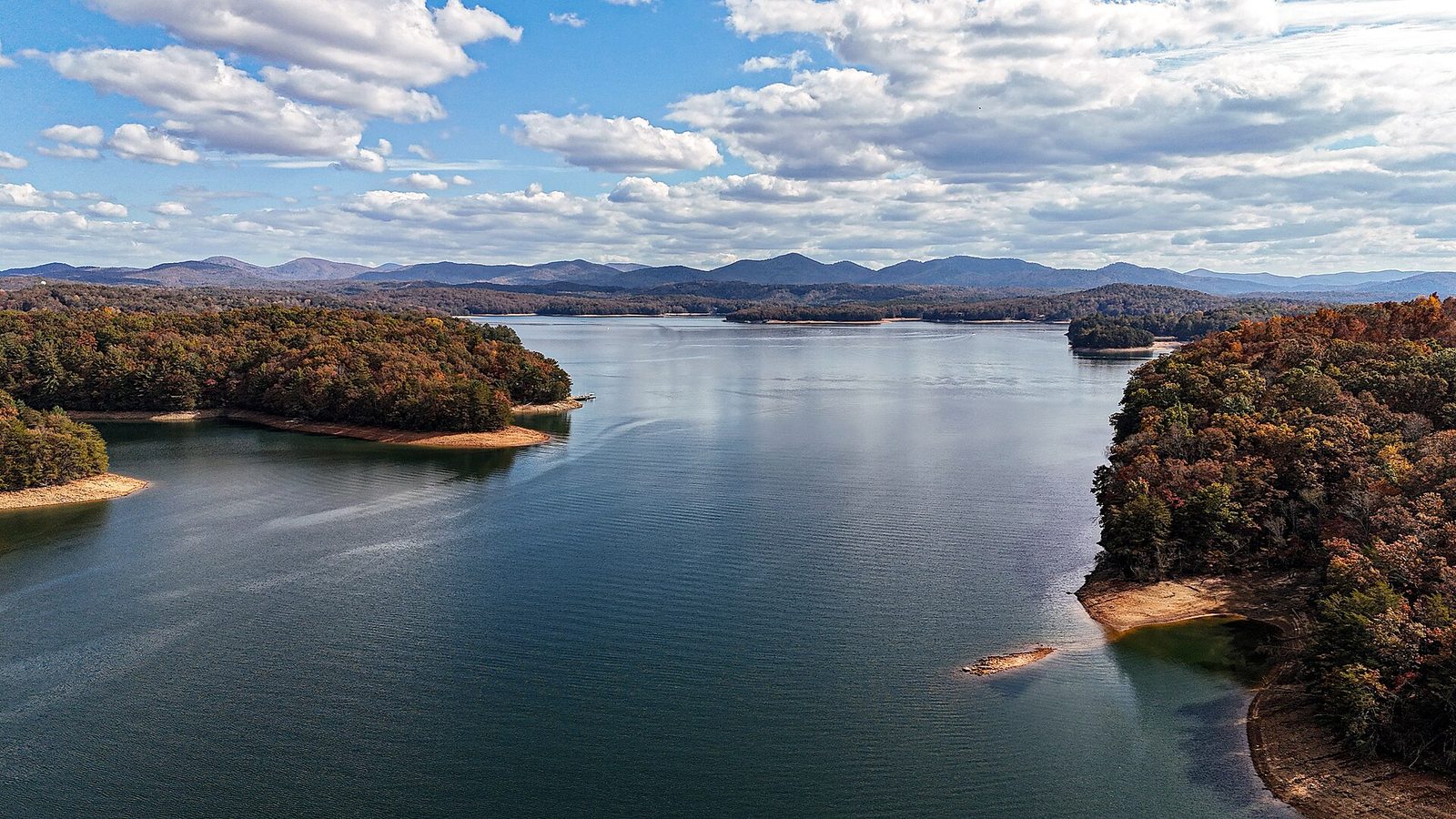
Lake Blue Ridge, Lake Nottely and Lake Chatuge are Tennessee Valley Authority reservoirs, and Lake Allatoona and Lake Lanier are Corps of Engineers. All of them are drawn down over the winter for flood storage and drawn back up in spring.
The consequence for a lakefront booking is direct: a dock that sits in eight feet of water in July can be sitting on dry ground in January, with a hundred yards of exposed lakebed between the deck and the water. Listings do not mention this, and the photographs are all summer. If the water matters to your trip, book between late spring and early autumn, or ask the management company what the lake level is doing on your dates. If the view is what matters, winter is fine and considerably cheaper.
Dogs
North Georgia is unusually good for dogs and most rental companies have a substantial pet-friendly inventory, almost always for a per-stay fee that is taxed like everything else. Filter for it at the search stage rather than asking afterwards: arriving with an undeclared dog will get you charged and can get the booking cancelled.
Georgia’s state parks are better still. Leashed dogs — a six-foot leash, owner present — are welcome on almost all park trails, and more than 40 parks take dogs of any breed or size in their campgrounds with no extra pet fee. State park cottages are the exception: only some are dog-friendly, and the filter exists on the booking system for a reason.
Practical notes for the mountains specifically: bears are present across the region and a dog left outside overnight is a bad idea; ticks are heavy from spring through autumn; and the rivers run faster and colder than they look.
Accessibility
This is the weakest part of the market and it is worth being blunt. A great many north Georgia cabins are multi-level, built into a slope, with a flight of steps from the parking area to the door and bedrooms on a second floor or in a loft. “Single level” in a listing may still mean five steps up from a gravel pad.
What works better: state park cottages, a number of which are built and designated as accessible and can be filtered as such on the booking system, along with accessible campsites; and the lodges at Amicalola Falls and Unicoi, which are hotel-standard buildings with lifts. For a private cabin, phone the management company and ask specifically about steps from the car to the door, thresholds, bathroom layout and the driveway surface. Do not rely on a checkbox.
Booking, Cancellation and Storms
Windows. October weekends in the mountains go six to twelve months out, and the best properties at the longer end. Summer weekends want two to three months. Midweek between January and March you can often book within days, at roughly half the rate. State park cottages open 13 months ahead, 14 for Georgia residents.
Minimums. Two nights is standard, three on holiday weekends, and a week is common over Christmas and in peak October.
Cancellation. This varies enormously and is the term to read before you pay. Marketplace bookings follow the platform’s policy; direct bookings with local management companies follow the company’s own, which is frequently stricter — a common structure is full refund beyond 30 or 60 days, partial inside that, nothing inside 14. Georgia State Parks takes a 50% deposit when you book 15 or more days out, with the balance at check-in, and full payment inside 14 days.
Weather. Almost no cabin contract in Georgia refunds for snow, ice or a power cut, because none of those makes the property unavailable in the legal sense. North Georgia gets a serious ice event every few years; roads close, gravel driveways become impassable and power can be out for a day or more. If you are booking January or February, take a vehicle that can cope, keep the tank full, and consider travel insurance rather than expecting flexibility from the operator.
Where to Book, and Why We Are Not Telling You Which Cabin
Full disclosure on method: this guide takes no commission from any rental company, marketplace or tourism board, and does not recommend individual properties. Cabin inventory turns over constantly, a named property today may be off the market in six months, and any list of “the ten best cabins” is either advertising or out of date. What is stable is the framework above — taxes, roads, views, booking windows — so that is what this page gives you.
On where to book: marketplaces such as Airbnb and Vrbo have review volume, a payment dispute process and a consistent cancellation policy, and they collect and remit Georgia’s lodging taxes for you. Local management companies in Blue Ridge, Ellijay and Helen often list the same properties directly, sometimes without a platform service fee, and — the real advantage — have a person forty minutes away who can deal with a failed water heater at ten at night. For a first booking in an unfamiliar area, the marketplace is the safer default. For a repeat trip, book direct with the company that looked after you.
Either way, read recent reviews for the specific things this page flags: the driveway, the signal, the view in the month you are going, and whether the hot tub was clean.
Season by Season
October is the market. Rates peak, minimum stays extend, and the best properties for the last two weekends of the month are taken six to twelve months out by repeat customers. If you want a cabin then, treat it as an annual booking rather than a decision.
Summer is the second peak and a different crowd — families, lake access, tubing in Helen, and two-to-three-month lead times. It is also when the view disappears behind leaves and when the hot tub is least appealing, so the properties to chase in July are the ones near water rather than the ones on a ridge.
Spring is the quietly correct answer. April and May give you waterfalls running full from winter rain, dogwood and mountain laurel, comfortable temperatures, shoulder-season rates and no crowds. The one drawback is pollen, which coats north Georgia in late March and April.
Winter is where the value is. Midweek in January and February, rates fall by roughly half, the leafless woods restore the views the listing photos promised, and Amicalola and Anna Ruby run hard and sometimes freeze. The trade-offs are real — ice on gravel driveways, some restaurants closed midweek, occasional power cuts — but for two people who want a fire and a book, nothing else in Georgia competes on price.
One scheduling note that catches people: Christmas week and New Year are priced like October and often carry a seven-night minimum, and the small-town restaurants you were counting on may be shut for the holiday.
Frequently Asked Questions
How much do cabins in Georgia cost?
State park cottages run $75 to $250 a night with no cleaning fee. Private rental cabins vary enormously by size, season and view, and the advertised rate is not the total: expect a cleaning fee, possibly a damage waiver of around $60, the state’s $5-per-night hotel-motel fee, 4% state sales tax on the rate and the cleaning fee, and a local excise tax of 6% to 8%.
Where are the best cabins in Georgia?
Fannin County around Blue Ridge has the largest and most varied inventory and a downtown worth walking to. Gilmer County around Ellijay is cheaper for much the same thing. Rabun and Towns are quieter and better for hiking. For value and location together, state park cottages at Vogel, Unicoi and Black Rock Mountain beat almost anything private.
How far in advance should I book a Georgia cabin?
Six to twelve months for an October weekend. Two to three months for summer. Days, if you are going midweek in January or February, when rates are roughly half. State park cottages open 13 months ahead, or 14 months for Georgia residents.
Do I need four-wheel drive for a north Georgia cabin?
Often not, but sometimes genuinely yes. Many cabins sit up unpaved switchbacks where a low car struggles in rain and cannot cope with ice. Ask the management company how long the gravel is and how steep the final approach gets, and take the answer seriously in winter.
Will my cabin have a cell signal?
Frequently not. Coverage across Rabun, Towns and Union counties is patchy and a cabin in a hollow can be dead. Most have satellite or fixed wireless internet, which usually handles browsing but often will not handle video calls. Ask what the connection is before assuming you can work from it.
Are Georgia cabins dog-friendly?
Many are, almost always for a fee, and you must declare the dog at booking. Georgia’s state parks are better: leashed dogs are welcome on nearly all trails and in over 40 campgrounds with no pet fee, though only some park cottages take them.
What does “mountain view” really mean?
Usually a view from November to April. The photograph was taken with the leaves off. Long-range views that survive summer foliage exist, cost more and are advertised as such — so if you are booking for July, ask for a recent photo of the view in that month.
Is lakefront worth it in winter?
Only for the view. Lake Blue Ridge, Nottely and Chatuge are drawn down over winter for flood storage, so a dock that floats in July can be sitting on dry lakebed in January. Rates are lower then for exactly that reason.
Most cabin weekends in north Georgia are really hiking weekends, and the trailheads worth reaching are rarely the nearest ones. Our guide to the best hikes in Georgia sorts thirty-eight trails by objective rather than by ranking — best first hike, best waterfall, best when it is ninety-five degrees — with honest distances, parking realities and the autumn hunting dates worth knowing before you set off from the porch.
A cabin is one answer to the lodging question, not the only one, and for two people on a two-night trip a hotel or a state park cottage often works out cheaper once the cleaning fee is counted. If you are still deciding between cabin country and a coastal or city base, our guide to where to stay in Georgia compares the regions side by side, with rate tiers and every fee that lands on top of the advertised nightly rate.
A cabin for two is a different purchase from a cabin for eight, and the thing that decides whether a couples’ weekend works is almost never the hot tub — it is how far the drive to dinner is. Our guide to romantic getaways in Georgia applies that test across ten destinations, and names the mountain towns where a beautiful rental leaves you forty minutes from a kitchen that is still open.
Couples are the hardest group to book a north Georgia cabin for, because the rental stock is dominated by three-bedroom family properties and the listings that market themselves as romantic are frequently the same cabins with a different cover photo. Our guide to romantic cabins in north Georgia sets out seven screening criteria, works through the real total once state and county lodging taxes land, and says which mountain county suits which kind of weekend.
A hot tub is listed on almost every north Georgia cabin above the budget tier, which makes it useless as a search filter and hides the things that actually differ: whether it is overlooked, whether it is drained between guests, whether it will be at temperature when you arrive and whether it is switched off for part of the year. Our guide to north Georgia cabins with hot tubs works through all of it county by county, with the questions to ask a host before you pay.
Related Georgia Guides
- North Georgia mountains guide — the base towns compared, fall color by elevation, roads and drive times.
- Best Georgia state parks — all 49 by drive time, the ParkPass rules and the cottage booking window.
- Best weekend getaways in Georgia — fourteen short breaks ranked, with the fixed costs laid out.
- Best places to visit in Georgia — 35 destinations across the state.
Photo Credits
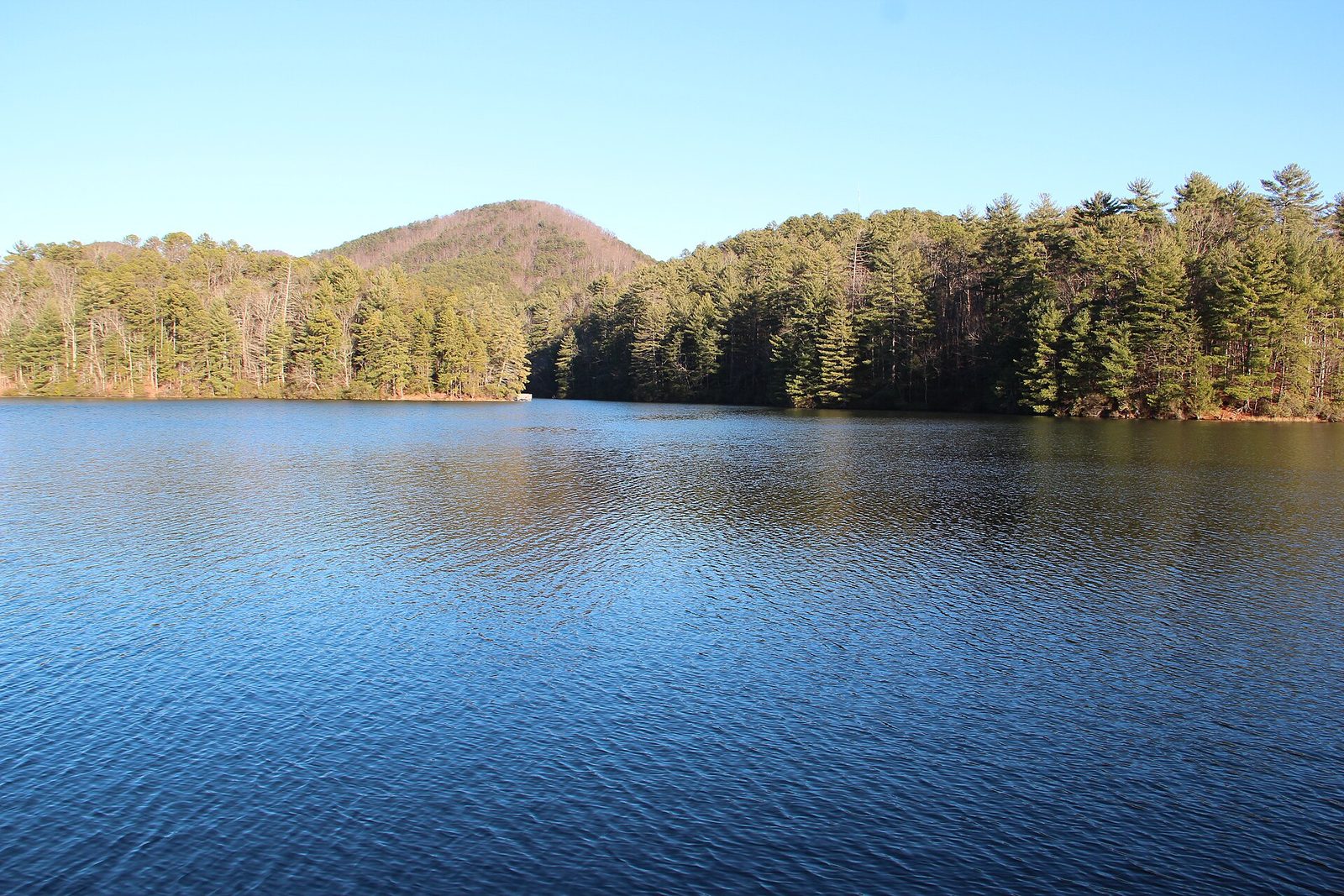
Lake Blue Ridge in autumn (featured image): photo by Stephen Rahn from Acworth, GA, USA / Wikimedia Commons (CC0)
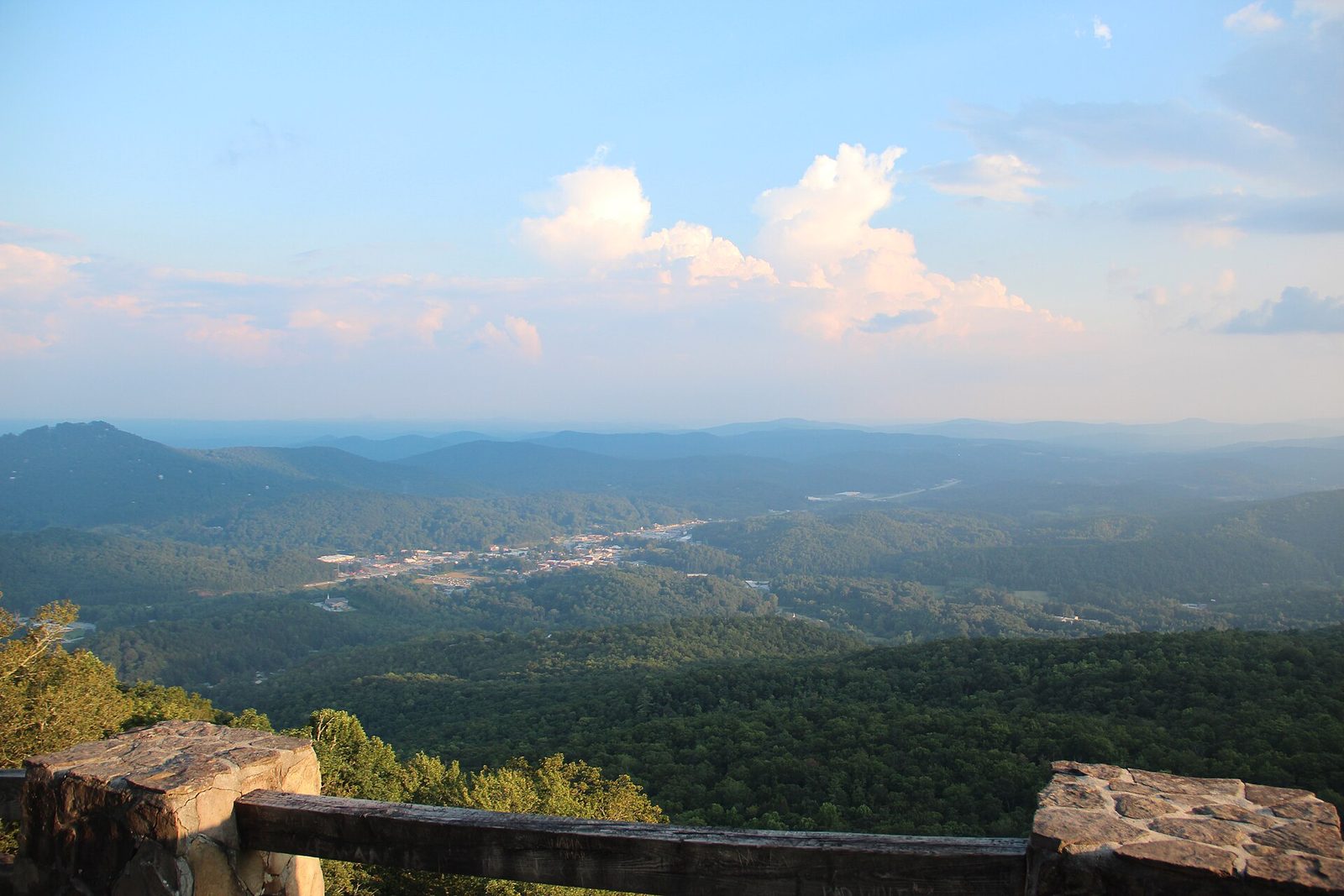
View from Black Rock Mountain State Park: photo by Thomson200 / Wikimedia Commons (CC0)
Unicoi State Park in winter: photo by Thomsonmg2000 / Wikimedia Commons (CC0)
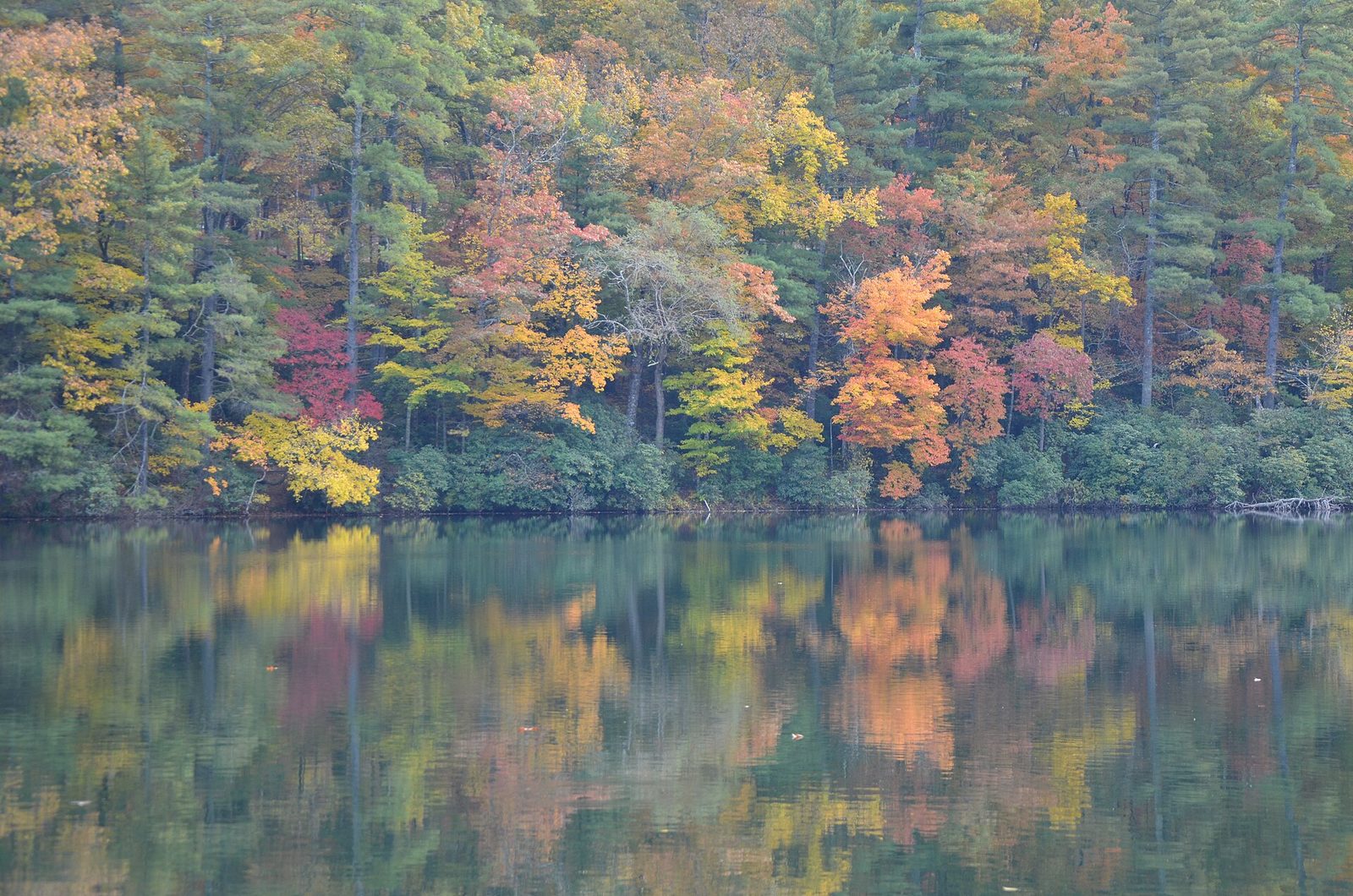
Autumn colors on Lake Trahlyta, Vogel State Park: photo by ChattOconeeNF / Wikimedia Commons (CC BY 2.0)
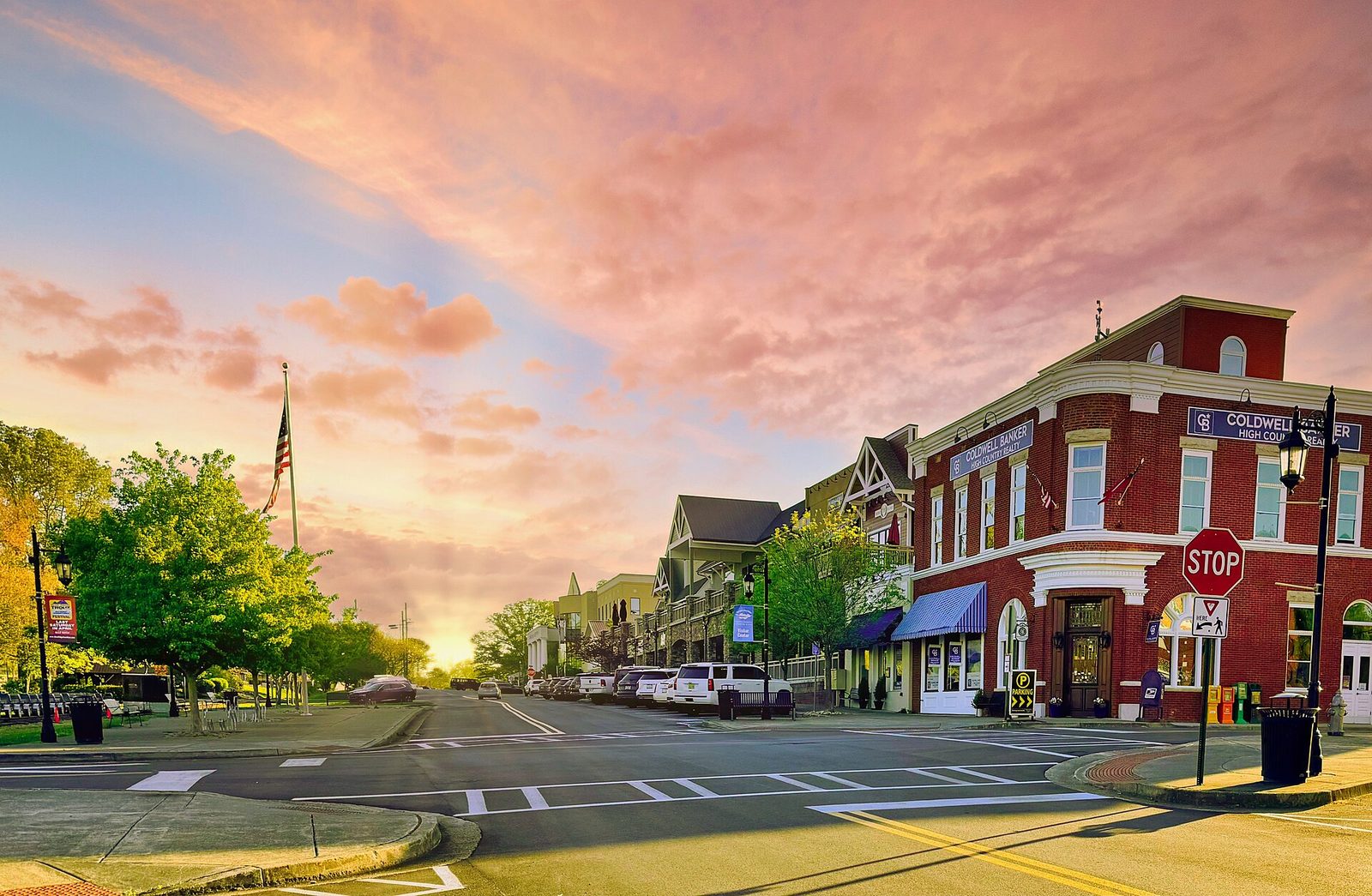
Downtown Blue Ridge at sunset: photo by Harrison Keely / Wikimedia Commons (CC BY 4.0)
Sources and Corrections
Georgia’s $5-per-night state hotel-motel fee and the 4% state sales tax treatment of cleaning and pet fees are per the Georgia Department of Revenue and Avalara MyLodgeTax, September 2026. The Fannin County 6% and City of Blue Ridge 8% excise rates are per the Fannin County Chamber of Commerce; other counties set their own and should be checked individually. The $60 damage-protection waiver is one Blue Ridge operator’s published figure, not an industry standard. State park cottage, yurt and campsite bands, the reservation window and the deposit structure are per Georgia State Parks. The 1 July 2026 human-trafficking-awareness training requirement is per Georgia short-term rental regulation. Private cabin nightly rates vary too widely by property and date to publish and none are quoted. This guide takes no commission and recommends no individual property. Fees change; if you find something here out of date, we want to know.
Georgia Tourism Guide is an independent publication. We are not affiliated with Explore Georgia, the Georgia Department of Natural Resources, the National Park Service or any attraction listed here.